Offloaded inference for real-world physical AI robotics
Artificial intelligence Audio & acoustics Computer vision Graphics & multimedia Human-computer interaction Human language technologies Search & information retrieval Data platforms and analytics Hardware & devices Programming languages & software engineering Quantum computing.
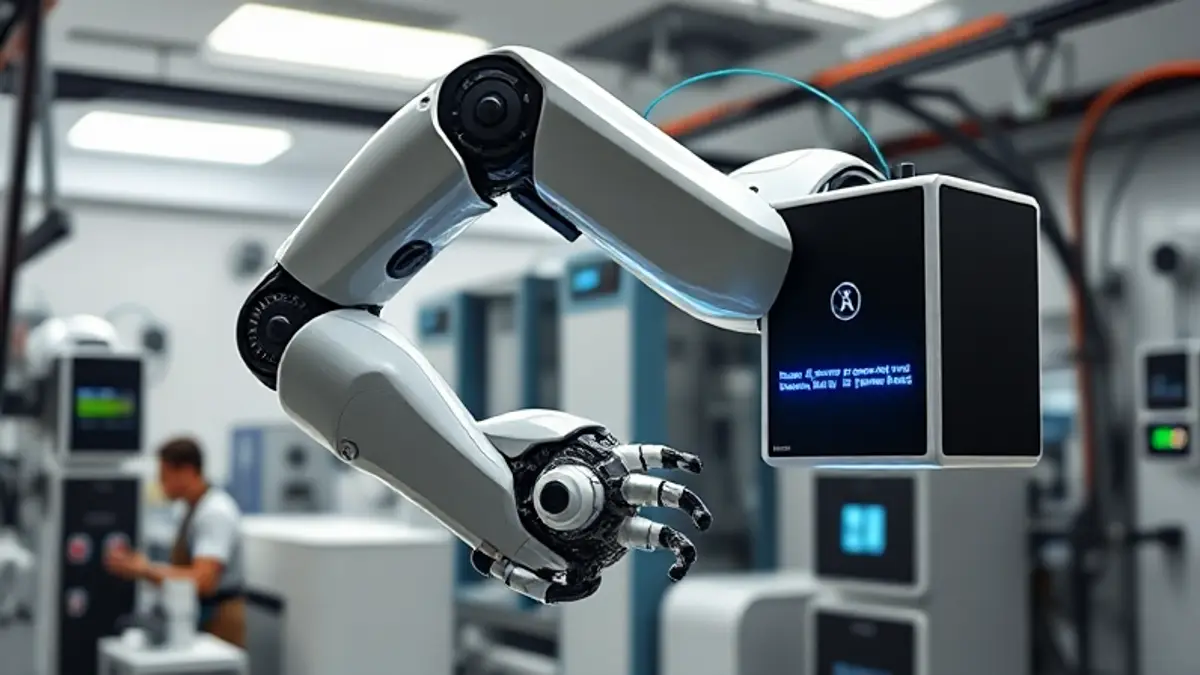
- Extends robot operating time: Replacing power-hungry onboard AI compute with lightweight onboard hardware and remote inference can substantially improve battery life, enabling robots to operate longer between charges.
- We evaluated representative models across three core capabilities: semantic mapping and planning, navigation, and manipulation, as summarized in Figure 2.
- Figure 2: Details of the models used for the different components of mobile manipulation.
Artificial intelligence
Audio & acoustics
Computer vision
Graphics & multimedia
Human-computer interaction
Human language technologies
Search & information retrieval
Data platforms and analytics
Hardware & devices
Programming languages & software engineering
Quantum computing
Security, privacy & cryptography
Systems & networking
Algorithms
Mathematics
Ecology & environment
Economics
Medical, health & genomics
Social sciences
Technology for emerging markets
Academic programs
Events & academic conferences
Microsoft Research Forum
Microsoft Research Blog
Microsoft Research Podcast
Microsoft Research Stories
About Microsoft Research
Careers & internships
People
News & awards
Asia-Pacific
Cambridge
Catalyst Lab
India
Montreal
New England
New York City
Redmond
Other research groups
Register: Research Forum
Microsoft Security
Azure
Dynamics 365
Microsoft 365
Microsoft Teams
Windows 365
Microsoft AI
Azure Space
Mixed reality
Microsoft HoloLens
Microsoft Viva
Quantum computing
Sustainability
Education
Automotive
Financial services
Government
Healthcare
Manufacturing
Retail
Find a partner
Become a partner
Partner Network
Microsoft Marketplace
Software companies
Blog
Microsoft Advertising
Developer Center
Documentation
Events
Licensing
Microsoft Learn
Microsoft Research
View Sitemap
Return to Blog Home
Microsoft Research Blog
At a glance
Challenges a core assumption in robotics AI: Our research shows that running physical AI inference exclusively on onboard GPUs can limit robot performance, battery life, and scalability, and that offloading inference to edge or cloud GPUs can offer significant advantages.
Demonstrates measurable benefits of inference offloading: Across representative mobile manipulation workloads, offloading improved task success rates, enabled larger AI models, and helped robots respond more effectively in dynamic, real-world environments.
Extends robot operating time: Replacing power-hungry onboard AI compute with lightweight onboard hardware and remote inference can substantially improve battery life, enabling robots to operate longer between charges.
Introduces a new capability in the Physical AI Toolchain: Developers can now containerize, deploy, and orchestrate robotics AI workloads across robots, edge infrastructure, and the cloud using Kubernetes-based tooling for distributed inference.
Readily-available physical AI, with robotics assisting users in manufacturing, home, and warehouses scenarios, holds immense potential to improve safety, productivity, and assistance across a wide range of tasks. In many ways, AI for the physical world represents a major frontier for AI . Physical AI must operate in open, unpredictable environments, interact with both other robots and people, and work with a diversity of embodiments. Realizing this vision requires advances along three dimensions: robot hardware, embodied AI models, and systems infrastructure for training and inference. While robot hardware and the AI models have advanced rapidly in recent years, we turn our focus on a relatively under-addressed aspect: inference infrastructure of physical AI . Enabling robots to effectively and safely operate in the physical world will require sophisticated systems to handle large volumes of distributed inference compute.
Today, the prevailing approach to physical AI is to provision a GPU onboard the robot, e.g., by wiring a GPU to the robot. In this model, the robot’s inference will be confined to the onboard GPU, and provide the robot with the necessary chunks and sequence of actions for the execution of its tasks. While higher-level planning may be performed in the cloud, task execution typically remains tied to the robot itself. We challenge this assumption. As physical AI models grow in size and sophistication, the constraints of onboard compute become increasingly apparent. GPUs consume significant power, reduce battery life, add cost and weight, and can limit the ability to run the latest generation of AI models.
To better understand the systems implications of physical AI, we conducted the first systematic study of robotics workloads. We focused on mobile robotic manipulation , with the canonical task such as “check for rubbish in the kitchen and put it in the trash.” Such a task involves planning the path to the kitchen, perceiving the environment to find rubbish, navigating to the rubbish, picking up the rubbish, and navigating back to the trash can for disposal. We evaluated representative models across three core capabilities: semantic mapping and planning, navigation, and manipulation, as summarized in Figure 2.
Figure 2: Details of the models used for the different components of mobile manipulation.
Offloading physical AI inference out of the robot improved its response time and accuracy, along with battery lifetime and cost. We evaluated the inference models across a range of onboard, edge, and cloud compute configurations. Details of the specific test hardware are available in our technical report .
Benefits in task performance : Our evaluation shows offloading inference can significantly improve robot performance across mapping, planning, navigation, and manipulation workloads. Some smaller GPUs could not accommodate the mobile manipulation stack. On GPUs with sufficient memory, mapping and planning slowed by up to 383% compared to an A100, thus limiting the robot’s abilities in dynamic spaces. Navigation showed a 30% drop in its timely detection of obstacles with lighter GPUs. While the VLA models did not dramatically slow down with smaller GPUs, the slowdown was still sufficient to drop their accuracies by 50%. In other words, onboard GPUs limited the performance of the robots while offloading their inference to an on-premise or cloud GPU boosts their operations, as shown in the videos below and quantified in the graphs. As physical AI models continue to grow in size and complexity, the benefits of offloading are likely to become even more pronounced.
Figure 3a: The video shows the handover task with onboard GPUs.
Figure 3b: The video shows the handover task when the inference is offloaded.
Figure 4: Success rates of robot arms handing over objects to each other when inference is performed with different GPUs (some onboard, and some offloaded). Offloading improves success rates.
Benefits in battery lifetime : Beyond performance, onboard GPUs also significantly drained the battery life of the robot. We compared the increase in battery lifetime by replacing an onboard GPU with a Raspberry Pi-5 board and shipping all the data to the offloaded GPU. The larger onboard GPUs, such as Jetson Thor, drained robot batteries by up to 160% (or a few hours) for even the larger robots.
Figure 5: Impact of offloading GPU inference on the battery life of the robots; the above numbers are for the Stretch-3 robot.
The above results show that offloading GPU inference out of the robot is critical for functioning in the open world with large models and long battery lifetimes. Nonetheless, offloading inference out of the robot involves a complex tradeoff involving performance, network latency and bandwidth, and available GPU resources. We believe that our measurement study will inform the design of physical AI inference systems.
PODCAST SERIES
Ideas
Listen as members of the research community at Microsoft discuss the beliefs that animate their research, the experiences and thinkers that inform it, and the positive human impact it targets.
Opens in a new tab
Toolset for automatic offload
We have built a toolset for easy inference offloading out of the robot and distributing inference between the edge GPU and cloud. Kubernetes is a natural platform to provide a uniform abstraction to distribute robotic AI between the robot’s compute, edge GPU, and overflowing to the cloud. The toolset allows automatic containerization and offloading of robotics workloads using declarative specifications, distributes physical AI containers with smart policies using Kubernetes, and integrates with robotic simulators, LeRobot, and ROS2 for easy development. The sequence of steps below shows how the toolset can be prompted with what to offload, and how it creates a separate container for GPU inference and offloads the same.
Figure 6: Steps in the offloading toolset with containerization and deployment.
Microsoft has recently released the Physical AI Toolchain (opens in new tab) for operationalizing physical intelligence at scale. Physical AI Toolchain is an open-source, production-ready framework that integrates Microsoft Azure (opens in new tab) cloud services with NVIDIA’s (opens in new tab) physical AI stack, accelerating robotics and physical AI developers to automate and scale data curation, augmentation, and evaluation across perception, mobility, imitation learning, and reinforcement learning pipelines. We are announcing the addition of an industry-first capability for offloaded physical AI inference for robots as part of the Physical AI Toolchain. This release includes example projects for offloading inference of a SO-101 and a UR10e. The videos below show the offloading of the inference of Microsoft’s Rho model , targeted at dual-arm robots, to a Jetson Thor GPU, which controls the actions of the Mobile Aloha robot (opens in new tab) .
Figure 7a: Offloading of GPU inference of Microsoft’s Rho model controlling the Mobile Aloha robot for interactions with the BusyBox to press the blue button.
Figure 7b: Offloading of GPU inference of Microsoft’s Rho model controlling the Mobile Aloha robot for interactions with the BusyBox to turn the knob to position 4.
Check out the inference offload feature, look into the source code, and let us know your feedback. We have already tested it with many real-world use cases, and look forward to hearing about your deployment experiences.
Opens in a new tab
Offload or Overload: A Platform Measurement Study of Mobile Robotic Manipulation Workloads
Meet the authors
Ganesh Ananthanarayanan
Senior Principal Researcher
Learn more
Matthew Balkwill
Principal Software Development Engineer
Learn more
Xenofon Foukas
Principal Researcher
Learn more
Sanjeev Mehrotra
Software Architect
Learn more
Bozidar Radunovic
Senior Principal Researcher
Learn more
Connor Settle
Senior Software Engineer
Learn more
Ankit Verma
Software Engineer
Learn more
David White
Principal Software Engineer
Microsoft
Learn more
Shawn Cicoria
Principal Software Engineer Lead and Architect
Microsoft
Learn more
Mark Martin
Multidisciplinary Engineering Manager
Microsoft
Learn more
Rachel Johnson
Software Engineer II
Microsoft
Learn more
Mayur Patel
Principal Technical Program Manager
Microsoft
Learn more
Research Areas
Systems and networking
CRAFT: Creative Robotics and Future Technologies
Follow us:
Follow on X
Like on Facebook
Follow on LinkedIn
Follow on Instagram
Surface Laptop Ultra
Surface Pro
Surface Laptop
Surface RTX Spark Dev Box
Explore Copilot
Explore Microsoft products
Windows 11 apps
Account profile
Download Center
Microsoft Store support
Returns
Order tracking
Certified Refurbished
Microsoft Store Promise
Flexible Payments
Microsoft in education
Devices for education
Microsoft Teams for Education
Microsoft 365 Education
How to buy for your school
Educator training and development
Deals for students and parents
AI for education
Microsoft AI
Microsoft Security
Dynamics 365
Microsoft 365
Microsoft Power Platform
Microsoft Teams
Microsoft Copilot
Small Business
Azure
Microsoft Developer
Microsoft Learn
Support for AI marketplace apps
Microsoft Tech Community
Microsoft Marketplace
Software companies
Visual Studio
Careers
About Microsoft
Company news
Privacy at Microsoft
Investors
Diversity and inclusion
Accessibility
Sustainability
Your Privacy Choices Opt-Out Icon
Your Privacy Choices
Your Privacy Choices Opt-Out Icon
Your Privacy Choices
Consumer Health Privacy
Sitemap
Sources
Related stories
European Retailers Adopt Open Models for Efficiency
NVIDIA reports European retailers are using open-source models to cut costs and improve operations.
NVIDIA and South Korea Collaborate on Physical AI Advancements
NVIDIA is supporting South Korea's physical AI development through industry partnerships and advanced computing tools.
The State of Chinese Physical AI
🎧 Audio version (or download audio for later): Good Morning, Dermot McGrath is an Irish entrepreneur and advisor based in Shanghai with over a decade in China. He founded ZenGen Labs, a research and strategy advisory firm focused on AI, robotics, energy and advanced.
VLLM Release v0.34.0 Adds New Models and Performance Enhancements
VLLM v0.34.0 introduces 10 new models and performance upgrades for specific hardware.
NVIDIA Hosts AI Day Seoul With Focus on Robotics and AI Agents
Over 2,000 attendees gathered at AI Day Seoul to explore advancements in robotics and AI agent development.
NVIDIA Unveils Advances in Robot Simulation and Learning
NVIDIA and partners reveal progress in robot manipulation through simulation at CoRL.